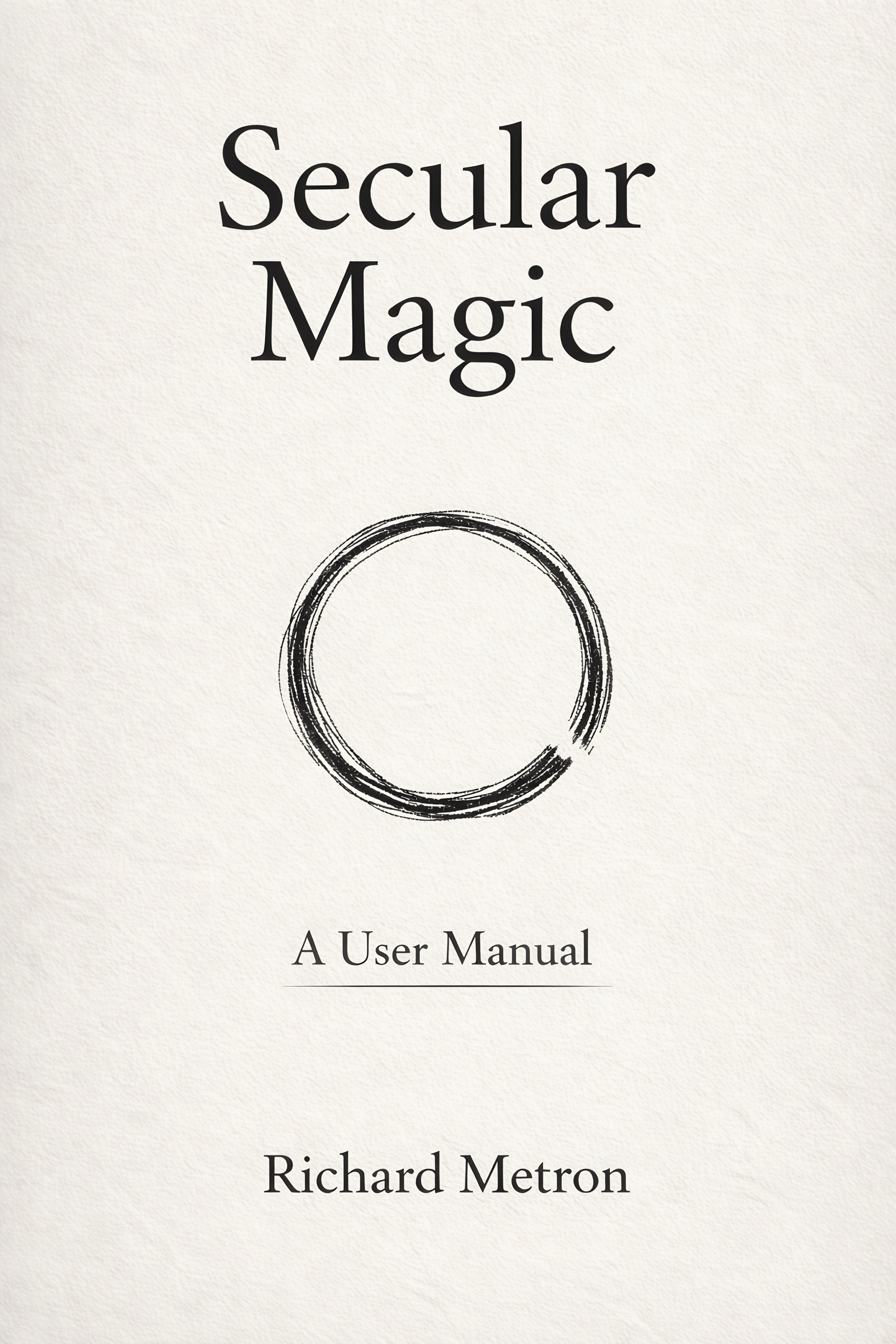
When intention, attention, and behavior line up, change moves through ordinary channels, and it can feel almost uncanny.
Most advice tells you to change your mindset or build habits. Ancient systems told you to perform rituals. Both often fail for the same reason, we say one thing and live another.
"Secular Magic, A User Manual" gives you a baseline, intentions that survive pressure, symbols that hold, a behavioral lock without self punishment, and a spellbook of situational rituals you can run when you are scattered, stuck, or overloaded.
How spells are organized, the five elements
The elements are not metaphysical substances. They classify system behaviors in a way that stays usable under stress, when attention is fragmented and the nervous system is loud.
Earth
Stabilizes
When you feel fragile, scattered, or easily disrupted.
Water
Moves
When emotions are stuck, suppressed, or overwhelming.
Fire
Increases
When you are inert, avoidant, or stalled.
Air
Clarifies
When thinking is cloudy, recursive, or stuck.
Void
Removes
When accumulation itself is the problem.
Element
EarthThe Grounding Loop
A predefined ritual pattern that reduces volatility and increases persistence. Use it when the system feels fragile, scattered, or easily disrupted.
Protocol
- Entry Plant both feet and feel three points of contact. Touch something you’ve chosen as your symbol (an object or a gesture). Name your state in one word: overloaded, panicked, or blank.
- Action Run a sensory loop: five things you see, four you feel on your body, three you hear, two you smell, one you taste. Let each exhale finish before the next.
- Containment Press your hands together, or place one on your sternum and one on your belly. Hold that weight for three breaths.
- Closure Say one word—grounded, back, or closed—then do one small physical action: drink water, sit down, or step outside for ten seconds.
Notes
Two minute version Feet planted, 3-2-1 senses, one longer exhale, touch your chosen symbol, then close.
Stop condition You can feel contact and name the next action without urgency.
Failure mode If agitation rises, you are moving too fast. Slow down and shorten the list.
Variation Substitute counting from ten to one if senses feel inaccessible.
Stacking Pairs well with Void after. Avoid Fire until steadiness returns.
Intellectual foundation
"Secular Magic, A User Manual" does not claim to invent these ideas. It reorganizes them into a usable structure.
Its foundations include habit formation research (Peter Gollwitzer), cognitive behavioral therapy (CBT), acceptance and commitment therapy (ACT), nervous system regulation (polyvagal theory), somatic approaches, mindfulness practice, systems theory (Donella Meadows), cybernetics, ritual studies, and pragmatic philosophy.
The elemental structure is borrowed from traditional esoteric systems, stripped of metaphysical claims and treated as psychological technology.
This is not belief. It is behavioral design.
Available in print and Kindle.
Buy on Amazon